







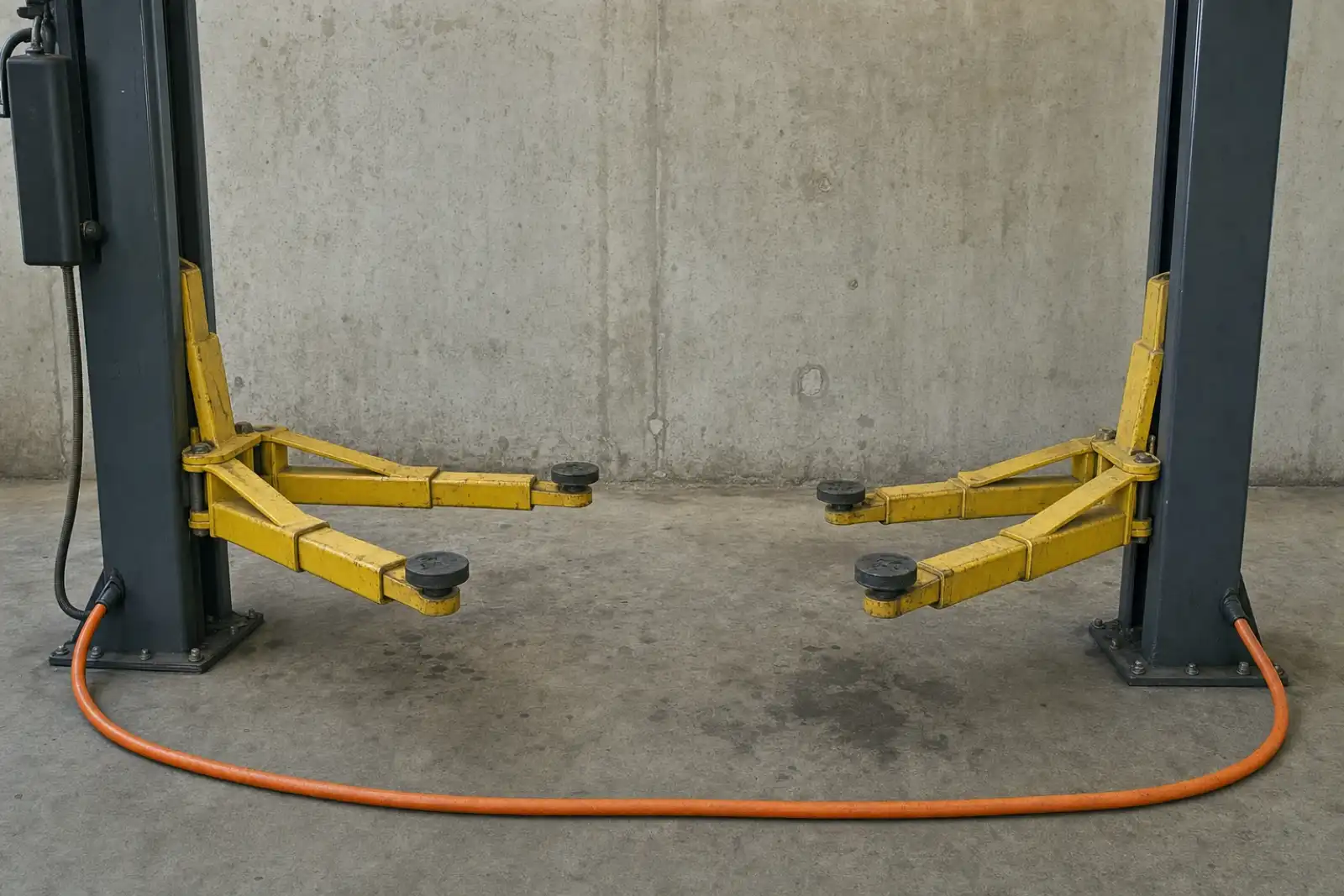
Only somebody qualified for it and appointed in writing by the business may work on a high-voltage system. Several levels are distinguished — and the lowest already covers what an independent garage mostly does to an electric car: tires, brakes, suspension, bodywork, servicing. It only gets demanding at the level above, and you need that less often than the discussion suggests.
The question actually asked in garages is rarely: how do I become a high-voltage specialist? It is: do I have to train every technician before an EV can go on the lift, and what happens if I do not? The answer depends on what you do to the vehicle — not on what drives it.
This article sorts out the levels, says which are sensibly filled in a business with five to fifteen people, and lists what has to be present alongside the certificates — the part systematically missing from course brochures. It deliberately names no course lengths and no fees: those differ sharply by provider, level and region, and a number off the internet is worthless for this decision.
Where high voltage begins and why that threshold is so low
In a vehicle, high voltage means anything above 60 volts DC or 30 volts AC. The traction batteries of current vehicles sit far above that, and the orange cable is the visible marking of it.
The decisive difference from everything else in a vehicle: a traction battery has no switch. It is a source carrying voltage for as long as it exists. What the business can do is make the system dead — disconnect it, secure it against being switched back on, establish that no voltage remains — and precisely those operations form the core of the qualification in question here. DC-link capacitors then need discharge time before work may genuinely be done dead; skip that wait and you have started the procedure rather than carried it out.
Behind all of this stands the principle that applies to every electrical installation: electrical work may only be done by a qualified person or under their direction and supervision. Which standard implements that where you are, which edition of it currently applies and what exactly the levels are called is something your trade association or your training institute will tell you — those numbers and names change, the system behind them does not.
You cannot switch a traction battery off. You can only disconnect it — and that is what the whole qualification is about.
The levels, in order of weight
| Level | What it permits | Typical work |
|---|---|---|
| Instructed person | working on an HV vehicle without touching the HV system, as long as it is intact and inherently safe | tires, brakes, suspension, bodywork, air conditioning, servicing, diagnostics |
| Qualified for work in a de-energised state | disconnecting, securing against reconnection, establishing absence of voltage and then working on the disconnected system | removing and refitting components in the HV area, making a damaged vehicle safe, removing the battery |
| Working live | operations on the energized system | measurements and interventions only possible live; in garage practice the exception |
The middle level is in practice often granted for defined activities: the technician is not a general electrical engineer but authorized for a precisely described set of tasks on the vehicle. That is the route garages usually take, and it is considerably leaner than a full electrical qualification.
What the lowest level does not cover
The moment the HV system is no longer intact, it stops. A damaged vehicle with a damaged battery, a vehicle with a triggered crash signal, visibly damaged orange cabling — that is not a case for the instructed person but for somebody with the disconnection qualification, and in case of doubt for the manufacturer or a specialist.

Which level your business really has to fill
The honest answer for an independent garage with five to fifteen people usually looks like this:
- All technicians at the lowest level. That is an instruction, not a course with an examination, and it is needed anyway the moment a hybrid or an EV comes onto your lift — which has been happening for a while, at the latest at a tire change.
- One or two people with the disconnection qualification. With that you can take on work where the HV system gets touched, and make a damaged vehicle safe instead of passing it on. Two people, because somebody has to be allowed a holiday.
- The third level as a rule not. Working live is rarely needed in repair; interventions at cell level are a matter for the manufacturer or a specialist anyway. Anyone considering this level should tie it to concrete jobs they would otherwise have to turn away — not to a feeling of wanting to be prepared.
The order matters: breadth first, then depth. A business where one person may do everything and the rest nothing runs aground on the day that person is ill — and on exactly that day it will move a vehicle nobody is allowed to move.
Qualification is not the same as appointment
The certificate says somebody can do it. They may only work once the business has appointed them in writing for the described set of tasks. That appointment belongs in the personnel file, it names the scope, and it gets amended when the scope changes. It is one sheet of paper and it is the most frequently missing building block.
Related articles
What the business needs alongside the certificates
The training is the part you buy. The rest is organization and equipment — and in an inspection it is the rest that gets asked about.
- A written risk assessment for work on HV vehicles, with the measures that follow from it. It is the basis for everything else and is required anyway.
- A defined working area you can cordon off and mark while work on the HV system is under way. No through traffic, no second technician coming to fetch something.
- Insulated tools and test equipment for the voltage level concerned, plus the personal protective equipment. Both have to be inspected periodically; the interval follows from the manufacturer's specification and your risk assessment, not from habit.
- Means of securing against reconnection and a warning sign that says both that work is under way and who disconnected it.
- A parking place for damaged batteries. Damaged traction batteries are a subject of their own — storage, transport and processing follow their own rules, and the transport falls under dangerous goods regulations. Arrange in advance where such a vehicle goes, rather than arranging it on the day it is standing on your yard.
- An emergency plan and first aid for an electrical accident, known to everybody, not only to the qualified.
- Documentation: instructions with date and signature, appointments, inspection certificates for the equipment.
This list is the real reason high-voltage competence is not finished with attending a course: equipment, recurring inspections and documentation run on as a permanent item in your fixed costs. It is at the same time the reason it is a barrier to entry — and therefore an argument that works for the business that has cleared it.

Whether it pays for itself: a calculation, not an opinion
Providers of these qualifications are the trade and training institutes of the motor sector, the technical academies and the manufacturers for their own systems. Prices and duration vary widely by level and region; the only reliable figures are quotations you have prepared for your specific level.
The calculation of whether it pays consists of four items on one side and one on the other.
| Item | What you count for it |
|---|---|
| Course fee | the provider's quotation for the specific level |
| Time out | course days times your labor rate, not times the wage |
| Equipment | insulated tools, test equipment, protective equipment, cordoning |
| Ongoing costs | equipment inspections, refresher training, documentation |
| What stands against it | jobs you would otherwise turn away — estimated realistically from your own customer base, not from new-car sales figures |
The second item is the one most often got wrong: a course day costs you not the technician's wage but the productive hour they do not sell in that time. What figure you have to work with before training pays for itself is what the labor rate calculator shows.
And once the qualification is there, it has to become visible on the invoice. Making an HV system dead and putting it back into service is an operation of its own with its own time, not an incidental that disappears into a line of text. How precise a job description has to be to carry its weight hangs on the same documentation you need in a dispute anyway.
Start with breadth: instruct all technicians, so that an EV at a tire change stops being a special case. After that, one or two people on the disconnection qualification, so you can take on work others pass along. The third level only pays once you can name which jobs it concretely brings in. And count the equipment list — that is the part not in the course price and the part an inspection looks at.
Running the garage without paperwork?
Jobs, labor units, parts and invoices in one system. From drop-off to the invoice, every line comes from the job.