






Table of contents
A full store feels like security and is in truth money lying on a shelf. The skill is not in holding as much as possible but in holding the right things: parts that are needed often, take a long time to procure, or cost little. Everything else should be ordered, not stocked.
For an independent garage the decision is harder than for a franchised one, because the spread of vehicles is wider. An oil filter that fits three model ranges is a different calculation from a control unit that belongs in one car. That distinction is the entire content of a stock strategy.
The second part is the question of how you notice that something is running out without counting every day. That needs no system — the most reliable answer is a second bin and a label.
A store is tied-up money
Every part on the shelf is paid for and only earns anything once it is fitted. Until then it causes costs that appear on no invoice but in the overheads of the business: the space, the tidying, the searching, and the loss in value when the vehicle it was meant for disappears from your customer base.
Against that stands the benefit, and it is real: a part on the shelf saves a day of standing time and turns a two-day job into a half-day job. So the decision is not a matter of principle but a judgment per item.
Hardly any garage knows how much money is currently on the shelf. The value appears in the accounts after stocktaking, but nobody carries it in their head during the year. A rough extrapolation — shelf meters, a sample, scaled up — is enough for the moment of realization and takes an hour.
The most expensive part on the shelf is not the one with the highest price. It is the one that has been there for three years.
Which parts belong on the shelf
Three quantities decide it: how often a part is needed, how long its procurement takes, and what it costs. Often, long and cheap argues for stock; rarely, quickly available and expensive argues against.
| Group | Examples | Decision |
|---|---|---|
| Consumables | oil, cleaner, cable ties, gloves, fasteners | always in stock, hold generously |
| Common wear items | popular filters, wiper blades, bulbs, batteries | stock them if they fit several vehicles |
| Vehicle-specific parts | brake discs, clutch kits, water pumps | order against the job |
| Expensive single items | control units, turbochargers, catalytic converters | never on spec |
| Material that ages | brake fluid, adhesives, sealant, tires | small quantities, arrival date on the container |
The fourth quantity is easily overlooked: some parts age on the shelf. Brake fluid draws water once the container is open, adhesives and sealants have an expiry date, batteries discharge, and tires carry a date of manufacture the customer can read. For these items a large holding is not merely expensive but professionally wrong.
Hazardous materials are a chapter of their own
Oils, brake fluid, cleaners, batteries and waste oil come under their own rules for storage and for what may be stored next to what — including, in most places, a duty to keep a register of the hazardous substances used on the premises. Which quantities you may hold and how is not a stock-strategy question but a workplace-safety one, and the fastest route to the answer is your trade association or the body responsible for workplace safety where you operate.
Reordering without counting every day
The classic stock mistake is not holding too little but noticing too late. The part is gone at the moment it is needed — and then a vehicle is standing.
The two-bin system
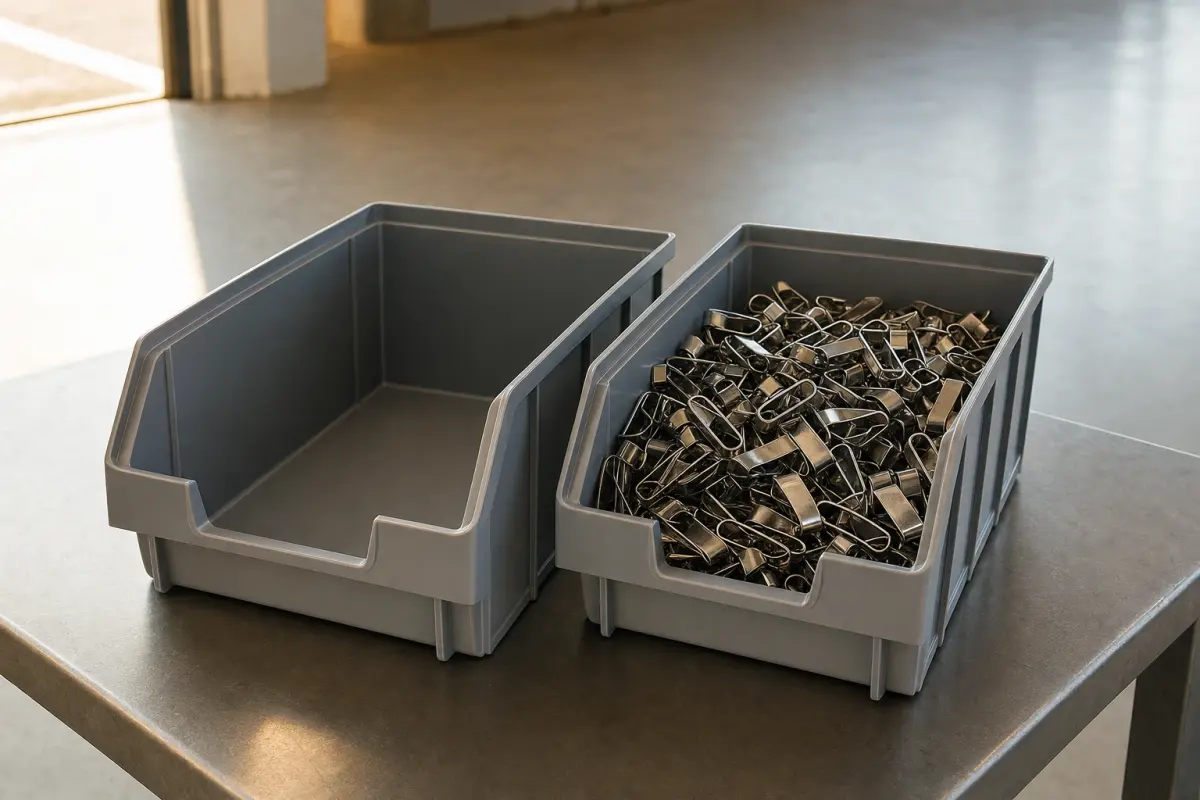
Every item gets two bins. You always take from the front one; when it is empty the rear one moves forward and the empty bin goes to a fixed place — a hook on the wall, a box at the parts counter. Whatever hangs there gets ordered. The stock in the second bin lasts exactly as long as procurement takes.
The method has three advantages: it needs no counting, no discipline about writing things down, and it works with the colleague who notes nothing. The only decision you have to make is the quantity in the second bin — and that follows from the consumption during your supplier's measured procurement time.
For everything that does not fit in a bin
With larger items a label on the shelf position does the same job: item, minimum level, order quantity, supplier. Whoever takes the last part above the mark writes it on the order list. Here too the rule matters more than the medium.
A stock module replaces exactly one move at this point — the noticing. It takes the item off the holding when it is booked to a job and reports the reorder level by itself. That assumes, though, that every withdrawal actually gets booked; where that is not kept up day to day, the second bin is more honest than a stock figure nobody trusts.
Related articles
Stocktaking: the duty, the date, the method
If you prepare accounts, you have to draw up an inventory at the end of each financial year and record your stock in it individually by type, quantity and value. That is not a formality — it goes straight into your annual accounts, and the rules that impose it are commercial law rather than good practice.
A full count between the years is not the only route. Most jurisdictions permit some form of simplification, and the three that recur are worth knowing by name so you can ask for them:
- Sample stocktaking — the holding is extrapolated using recognized statistical methods instead of being counted in full.
- Perpetual stocktaking — counting is spread across the year, provided the holdings are continuously recorded.
- Displaced stocktaking — the count happens within a window before or after the year end and is converted to the balance sheet date.
Which of these is admissible and sensible for your business is a question for your accountant, not for a rule of thumb: the conditions differ from country to country, and perpetual stocktaking assumes a stock ledger many small garages do not keep at all. Small sole traders are exempt from the bookkeeping and inventory duty altogether under certain turnover and profit thresholds in some jurisdictions — whether you fall under one, and what the thresholds currently are, is the same question to the same person.
Whatever the method, one thing holds everywhere: the records the holding is derived from have to be traceable and unalterable. That is the same demand the tax retention rules make of every record with a bearing on tax, and it applies to a stock list in a spreadsheet exactly as it does to software.

Spotting dead stock and getting rid of it
Every store collects parts for vehicles that are no longer in the customer base. They do not stand out, because they bother nobody — they simply sit there.
One move when putting things away makes them visible: the date of arrival goes on every part. A glance at the shelf then shows what has not moved in two years, without any report having to run anywhere.
What you do with what you find, in this order:
- Check for return. Some suppliers take shelf stock back once a year, often at a discount. The window is limited and announced in advance — miss it and you wait a year.
- Use it deliberately. A part that fits can go into the next suitable job even if another would be more convenient to order.
- Sell it on. At cost to a colleague still beats a permanent shelf position.
- Write it down. What is demonstrably no longer sellable belongs to be corrected downwards in the valuation. How that runs cleanly for tax is a question for your accountant.
The uncomfortable insight is usually the same: dead stock does not come from bad buying but from good intentions. One part more was ordered because the price was tiered, or a second in case the first did not fit. Both are understandable, and both end up on the shelf. Whatever margin you put on a part has to carry those leftovers too.
Stock what is needed often, takes long to procure and costs little — and order everything else against the job. For reordering, a second bin is enough; for dead-stock control, a date on the box.
Stocktaking is the appointment at which both take their revenge or pay off. Keep the holding small and orderly across the year and you count for a morning between the years instead of two days.
Running the garage without paperwork?
Jobs, labor units, parts and invoices in one system. From drop-off to the e-invoice, with nothing entered twice.